



All Insights
Mini Blog | Dated 17 September 2025
DBP Act Refresher Part 3: How Strata Managers can support Owners' Corporations
When the Design and Building Practitioners Act 2020 (NSW) came into effect, it created an immediate need to clarify its implications for Strata Managers, particularly in the context of remedial building work. It also opened the door for ongoing education and greater transparency across the sector.
As a Strata Manager, your responsibilities go far beyond day-to-day administration. You play a pivotal role in helping Owners Corporations understand and comply with the Design and Building Practitioners Act 2020 (NSW), particularly when it comes to remedial building work.
Strata Managers: Empowering Owners Corporations
As a Strata Manager, you play a vital role in guiding Owners Corporations toward best practice measures and ensuring that all projects are carried out in full compliance with the legislation.
As part of this, one of the best habits you can formulate is to ensure that any design or building practitioner that an Owners Corporation may engage has all the correct qualifications and is registered under the DBPA for the specific category of work to be undertaken.
As part of the DBPA, Design Consultants (General) must have the following qualifications:
Have the required qualifications, experience, skills and knowledge.
Have a current National Police Certificate that is no older than 4 months from when you submit your application (name and date of birth check only)
Have completed and passed the 2 mandatory Construct NSW learning modules
Meet insurance requirements.
Likewise, Building Practitioners (General) must have the following qualifications to be eligible:
Pathway 1: You must be a holder of an endorsed contractor licence authorising the holder to do general building work under the Home Building Act 1989.
Pathway 2: You must satisfy the qualification requirements to hold an endorsed contractor licence authorising the holder to do general building work under the Home Building Act 1989.
Building experience: You must have at least 5 years’ practical experience in the last 10 years, including at least 2 years in Australia, carrying out building work involving a class 2, 3, 9a or 9c building.
Refer To Full NSW Government Building Practitioner Eligibility
Understanding these qualifications and confirming DBPA registration, with a duration sufficient for project completion, will protect Owners Corporations. It ensures registration covers a period that is long enough for the completion of the project.
For work to existing buildings, Building Practitioners are required to take out HBCF (Home Building Compensation Fund) insurance and maintain eligibility.
HBCF (Home Building Compensation Fund): A scheme in NSW that assesses builders and tradespeople for insurance eligibility, setting limits on the work they can undertake. It provides a safety net for homeowners affected by incomplete or defective building work. Click here to read more about what HBCF covers
How can Building Practitioners be eligible for HBCF for residential work in NSW?
To manage this risk, builders must apply for eligibility before they can purchase a Certificate of Insurance. iCare NSW assesses the eligibility application and takes into account the following criteria:
- Financial performance
- Equity exposed to the building operations
- Technical capability
- Trading History.
Click here to read more about iCare HBCF Eligibility Criteria
The responsibility of proactive education as a Strata Manager
On many occasions here at Diagnostech, we have found ourselves on the receiving end of a lot of negativity surrounding the processes, timeframes and cost expectations now in place with this legislation.
As a Strata Manager, you can play an important role in helping your clients understand the DBPA is going to affect you and your clients so that you can educate your Owners Corporations, Strata Committee’s and relevant stakeholders on the impacts.
By proactively preparing your own communication to all relevant parties about how the DBPA has changed the building remediation process, you can help to alleviate, or at the very least, address much of the frustration and confusion that Owners and clients living in your managed apartment buildings are now facing.
This includes educating them on the cost considerations and time delays they can now expect when having remedial works scoped, implemented, and completed.
See the image below for the Section 106 duty of Owners Corporations to maintain and repair property as outlined in the NSW legislation which may lead to significant damages claims being brought by lot owners against an Owners Corporation.
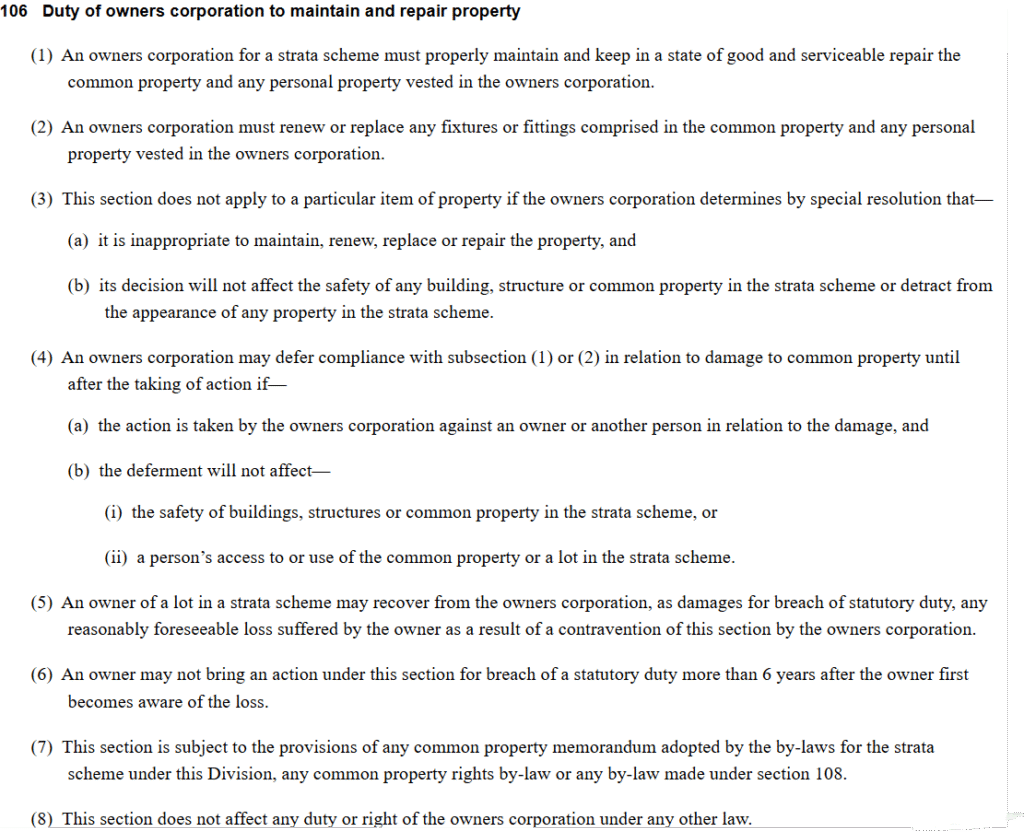
Figure 1. Section 106 Duty of Owners Corporation to maintain and repair property of the NSW legislation. Click here to see the Strata Schemes Management Act 2015 No 50
With the introduction of the 2025 NSW strata law reforms, owners corporations now face increased legal responsibilities to maintain and repair common property, an area where remedial building consultants can play a vital role. These changes will soon be backed by new enforcement powers granted to NSW Fair Trading, allowing them to issue compliance orders when maintenance obligations are not met.
For strata schemes dealing with ageing infrastructure or unresolved defects, this signals a shift toward greater accountability and urgency. Though the changes to the Act have passed both Houses, we will need the Regulations to be updated to see the details the Department will now need. As strata managers, you can support owners corporations by connecting them with qualified consultants, ensuring all remedial works comply with the Design and Building Practitioners Act and the updated strata legislation.
Diagnostech’s DBPA Capability
At Diagnostech, every one of our Diagnostech design practitioners is qualified and registered through the DBPA. Likewise, we only ever work with construction companies and contractors that are properly qualified and DBPA registered as well.
We are committed to keeping our clients up to date on the DBPA requirements and supporting owners in understanding the implications for their buildings.
While this article has been designed to provide you with all the information you might need to remain well-informed about the DBPA and how it will impact you, keep in mind that our team at Diagnostech are also available to provide guidance and help understand the implications for your clients or your building.
Glossary of Terms
| Term | Definition |
|---|---|
| Remedial Building Work | Remedial building work refers to repair, maintenance, upgrades, or defect rectification on existing buildings. It’s a broad term used to restore a building’s performance or compliance. |
| Design and Building Practitioners Act 2020 (NSW) – DBPA | The DBPA is legislation introduced in NSW to enhance accountability in construction by mandating practitioner registration, compliance declarations, and duty of care obligations. It ensures that both design and building work meet minimum standards. |
| Class 2 Building | A Class 2 building refers to residential apartments or townhouses with shared spaces like lobbies or basements. |
| Class 3 Building | Class 3 buildings are intended for long-term or transient accommodation for unrelated people, such as boarding houses or hostels. |
| Class 9C Building | A Class 9C building is a residential care facility that provides varying levels of physical assistance to residents, such as aged care homes. |
| Design Practitioner | Refers to a person who prepares regulated designs |
| Regulated Design | A Regulated Design is any design prepared for remedial work involving critical building elements like waterproofing or cladding. It must be developed by a registered practitioner and comply with legislation. |
| Exempt Works from Regulated Design | Works such as concrete repair or repainting are generally exempt from Regulated Design obligations. However, work on structural elements still requires proper supervision and may need approval. |
| Duty of Care (under DBPA) | The DBPA introduced a statutory duty of care requiring builders, designers, developers, and supervisors to avoid economic loss caused by defects. It applies broadly—even to building types outside DBPA. |
| Pafburn Case | In Pafburn Pty Ltd v The Owners – Strata Plan No. 84674 [2024] HCA 49, the High Court confirmed that head contractors and developers are responsible for defects caused by subcontractors, significantly extending liability. |
| Section 106 – Strata Schemes Management Act 2015 (NSW) | This section imposes a strict legal duty on owners corporations to repair and maintain common property in strata schemes. |
| Construction Issued Regulated Design | This is a final certified design prepared by a registered practitioner to ensure remedial work complies with DBPA and building codes. Required for Class 2 works and from July 2026 for Class 3 and 9C. |
What our clients say
"
Diagnostech were engaged by the owners corporation to investigate the cause of the water ingress affecting several apartments and provide recommendation for remedial repairs. David Chan has been an amazing engineer to work with, taking the time to explain in layman terms the cause of the fault, how the water enters the building and metholdology for repairs to comply with the legal requirements.
– Samantha Walker, Strata Assistant, Bright & Duggan
I have had the pleasure of working with Diagnostech on our current live project, and I can’t speak highly enough about the experience! From start to finish, their professionalism, expertise, and attention to detail were exceptional. Swahil Patil, Theriza and Raj took the time to thoroughly assess the complex issues and address them to ensure full compliance. Their wealth of knowledge is impeccable.
I highly recommend Diagnostech for any remedial engineering work. It’s rare to find someone so reliable and skilled, and I will definitely be reaching out for any future needs!
Thank you again for the fantastic service!
– Michael Parker, Senior Site Manager, RM Watson
What I find probably the most valuable thing about working with Diagnostech is that I really trust their advice and they have a very practical application to what we do and they understand our clients’ needs and just the way they deliver, they understand it.
– Rebecca Cleary, National EOS Optimisation Manager and Senior Director, Property & Asset Management, JLL
Diagnostech have been in the market for over 20 years. They’ve worked across a lot of buildings across Sydney and so they really have the know-how, technical knowledge and the ability to explain in layman’s terms to lay people, which is very valuable. Dennis truly is the most honest, integrity-driven building consultant out there.
– Sonia Jacob, Senior Buyers Agent – Residential, ProsperGroup
I enjoy working with Diagnostech because they have a detailed knowledge about buildings. Diagnostech are the experts and I know when I speak to them I can understand if what the client is seeking is relevant and they can provide the appropriate recommendation about how to handle a problem.
– Daniel Holt, Licensee in Charge, Strata Sense
We have enjoyed worked with Swahil & the team for the last year & would highly recommend them to anyone requiring façade engineering services on their project.
– Cardoe Contracting


